There is a unique and devastating grief I tend to feel after big days and events as a chronically ill autistic disabled person.
Writing has felt so intimidating to me over the past few years while I navigated a lot of intense life upheavals. But I really miss it – and you all – a lot. It’s meant more than I can say to see people are still visiting the site… There are still a lot of views every day despite my lack of posting. Like a lot a lot. 😳 But in some ways, that’s also added to the pressure I’m putting on myself.
I’d like to try posting more casually, with less pressure on myself to get things “perfect”. Sometimes… good enough really is good enough! If you agree, it would mean a lot if you interact with this post by liking it or leaving a comment. That way I can remind myself that something truly is better than nothing, and that a short or “imperfect” post is still valuable.
Autistically,
Alex 💜
My 100% is Actually My 500%
There is a unique and devastating grief I tend to feel after big days and events.
Since January, my work has been organizing a large-scale, city-wide event and I’ve been responsible for a lot of the behind-the-scenes coordinating and organizing.
This included efforts to make the event the most accessible it’s ever been – including my second year hosting a Sensory Support Space (Let me know if you’re interested in a post about that. I have a lot to say about it!) It’s an event that means a lot to me, and to my intersectional communities.
But inevitably, today I feel that all-consuming grief. And — like I mention in my post Navigating Autistic Grief & Anger — I somehow always manage to forget how much I struggle to navigate grief.
It’s the same grief I felt in college needing to have accommodations to work from the floor when needed. To have campus security bring me to and from classes. To spend 95% of my time trying to just do my best while doctors tried to figure out what was wrong. To have to wait for football players running down the halls to catch the elevator with me because they were late, and I was struggling to stand. Getting invites out and knowing that no – if I want to pass my courses – I literally could not.
It’s growing up undiagnosed and knowing you’re very different from your peers in so many ways, but you don’t know why. It’s the school nurse gaslighting you and calling you a liar when you’re overstimulated and in pain and confused. It’s watching friends get “perfect attendance” rewards when you’re just struggling to get through the day.
There’s a special type of grief when your 100% is actually your 500%.
When you can’t go out and party or celebrate with your coworkers after 6 months of planning together. (To be clear, I’m sure everyone would have welcomed me and tried their absolute best to accommodate me — I was just at the point where I literally was in able of anything other than staring at my ceiling in the dark.) But there’s that grief when you can’t do the post-event bonding to celebrate and hear how everyone’s day went. You can’t blow off steam together.
And you can’t bounce back the next day. You pay for overdoing it in full body pain and nausea and vertigo. And you pay for it for a very, very long time. Like weeks of time.
It’s isolating and lonely and it’s no one’s fault. Not even my body. It’s just doing its best. I’m just doing my best. And that’s the biggest grief.
Grief, like so many emotions, is an experience that relentlessly evades my expectations no matter the circumstances. It doesn’t matter how many times I try to “practice” a future incident or attempt to troubleshoot how I’m feeling. Grief is stubborn. Grief is creative. Grief is necessary. But goddamn… grief is a bitch.
This summer, I lost so much. In rapid succession, my life began to shatter and splinter outward in sharp, crackling edges. Let’s just say– if I’d been given a bingo card with the events of my life in 2022, I would have bet my existence there wouldn’t be a single winning bingo on it. But here I am– holding a tattered bingo card that’s been stamped so many times the ink has begun to bleed.
Grief’s gnawing, grating lament has been present for so many months now that I hardly feel it most days. But grief has found a new way to make me hear it again in the most unexpected way. This grief is like the ground after an earthquake, when the earth begins to liquify and water bubbles up through the cracks. This grief is unique, and feels decades old. And I suppose it is…
Grief, Regret, & Joy
In August 2022, after 20 long years, I was finally able to receive a total hysterectomy. I’m a trans nonbinary person with Polycystic Ovarian Syndrome (PCOS) and persistent gender dysphoria, and I have been fighting to receive this medical intervention for two thirds of my life. This victory should make me happy. It does make me happy. Indescribably happy.
But alongside this relief and joy is a dark swirling void in my chest that pulses sharply and shrieks to be heard. This void reminds me of things pushed into cages in the back of my mind.
It reminds me of 20 years of horrific and debilitating agony from large ovarian cysts that ruptured routinely throughout my life from ages 12 through 32. It reminds me of missed classes and days of work. Frantic trips to the ER. Fearful menstrual periods waiting frozen with terror for another bomb to go off inside of me. Invasive tests and stoney-faced unlistening doctors.
“Alongside this relief and joy is a dark swirling void that pulses sharply and shrieks to be heard.“
This insistent grief paints an uncanny and unwelcomed image of a 12 year old kid blacking out while home alone and waking up to a still-present, gut-wrenching pain that sadly wasn’t just a bad dream.
And more than anything, the black swirling void in my chest stirs and coils into a viper that reminds me that often with grief… comes rage. The viper in my chest spits out echoing reminders of betrayals and failures to protect. Of the hippocratic hypocrisy– “do no harm”. The echoes summon the memories, accompanied by the haunting grief… the rage.
“This shouldn’t happen again. It’s rare. You don’t need to worry.”
An image of a 12 year old terrified to walk down the stairs, scared to somehow set off another bomb inside. 20 years of it happening… again. And again. And again.
“Take these and it’ll stop.”
A just-barely teen cycling through half a dozen hormonal birth control medications, quickly followed by a quick succession of anti-depressants, chronic pain, and intense suicidal ideation.
“You don’t know you don’t want kids. You’re not 30 yet. What if you change your mind?”
A child, teen, then young adult begging for help from doctors, insisting that no child– even if it were wanted– is worth this daily dread. This indescribable agony that makes life seem unlivable.
“It’s just part of being a woman.”
A too-young child learning to dissociate so far outside of their body that the pain the body feels is like a flickering candle in a distant galaxy.
“Only come to the Emergency room if you’re bleeding through an entire pad.”
A young adult gasping, “I’m fine. This is normal.” while inwardly praying to either black out or die. Anything to escape the all-consuming pain that makes their vision go white.
“I’d trade you if I could.”
A confusing rage and deep, unfathomable sorrow that pools around the viper swirling inside.
Grief, Regret, and Moving Forward
I’m still not sure what to do with the gritty heaviness of this grief. This grief is dripping with poisonous rage and there’s nowhere to place it. No single person to direct it toward, demand answers from. Yet holding it inside grows challenging. How do you coil your rage around a systemic cage?
This rage is a part of my grief that I cannot lock away. Its molten heat merely melts the lock. I don’t know how to honor this anger. I don’t know how to look back at my past and tell my younger selves that they did everything right. They did nothing wrong. It wasn’t that they didn’t say the right words or do the right things. They tried so damn hard to be heard. They collected countless bruises and traumas, and they kept going anyway. They grew to be a warrior far stronger than many grown adults ever need to be, and far, far too young.
As reproductive rights continue to be challenged throughout the country, I grieve and I rage. Bodily autonomy is already denied despite documented “medical necessity.” Further barriers to medical care seem insurmountable in an already cruel and inhumane system which deliberately and callously silences minority voices.
And echoing in my mind is the question “Who defines ‘necessity’?” This question haunts me through my grief and my rage.
I look back and tell my 12 year old self…
“It was a necessity. It was a necessity for 20 years. It’s time to let yourself feel again. I am so damn proud of you, kiddo.”
Autistics are left behind when stereotypical Autistic behaviors or traits are used as the sole criteria when evaluating and diagnosing Autistics. While this can be damaging and impactful to boys and men as well, women and non-binary folks have been left behind, misdiagnosed, and written off at an especially alarming rate. This leads to so many issues, many of which I know firsthand as a non-binary Autistic who was only just diagnosed a few years ago at age 27.
It was once thought (and still thought by many) that the number of Autistic boys far outnumber the number of Autistic girls. But with more and more Autistics like myself speaking out as advocates, people are starting to realize just how untrue and damaging this misinformation truly is. While trying to re-educate neurotypicals, some advocates focus on the differences in how girls present versus how boys present. Others look at “internalized” characteristics versus “externalized” characteristics and the differences in how traits manifest which can sometimes vary between genders. I’m not sure what the answer is myself; I only know my own experience.
These are a few of the things I myself have experienced as an AFAB (assigned female at birth) non-binary Autistic diagnosed in my late 20s:
I learned early on to “mask” my Autistic traits, even though I didn’t realize they were generally not viewed as neurotypical things. I was bullied relentlessly in primary school, sometimes even by teachers. I didn’t know why I was a target, but I knew I was and that trauma forced me to sit back and watch. I latched onto peers and mimicked, painfully masking my instincts and following their examples in an effort to conform and fly under the bullying radar. Even as I begin my 30s, taking off that mask has been an alarmingly difficult process. I still can really only let my mask completely down around my wife, when I am free to verbally stim or rock or flap my hands in joy, use echolalia, let out verbal and physical tics, etc. I can’t describe how freeing that is.
Because of my “skill” at masking, I was more able to “pass” as neurotypical. The stress of doing this long-term leads to extreme stress, trauma, anxiety, and other mental health concerns. I myself have severe C-PTSD, social anxiety, a history of disordered eating, etc. I also live with fibromyaglia and chronic fatigue, and these become more severe when I have to mask for long periods of time. When you can’t understand why you are different and spend so much energy squashing yourself into a box, it takes a devastating mental and physical toll.
Some special interests (which folks sadly tend to pathologize rather than celebrate) may be less obviously “unique” and may therefore go unnoticed. For example, knowing every fact possible about One Direction vs. knowing every fact possible about trains. My own intense interests include Japan, Japanese language, singing, writing, art, and fantasy/sci-fi books. These hobbies have lead me to my college majors and careers; I am fluent in Japanese and spent several years living in Japan. I now write and create art as a form of self-expression and advocacy.
There is so much more to this topic. One main goal of my blog is to hopefully reach people who are like me. Folks who have always been different, but haven’t known why. I want parents to understand more about their kids. I want professionals to challenge the stereotypes they hold and listen to Autistics.
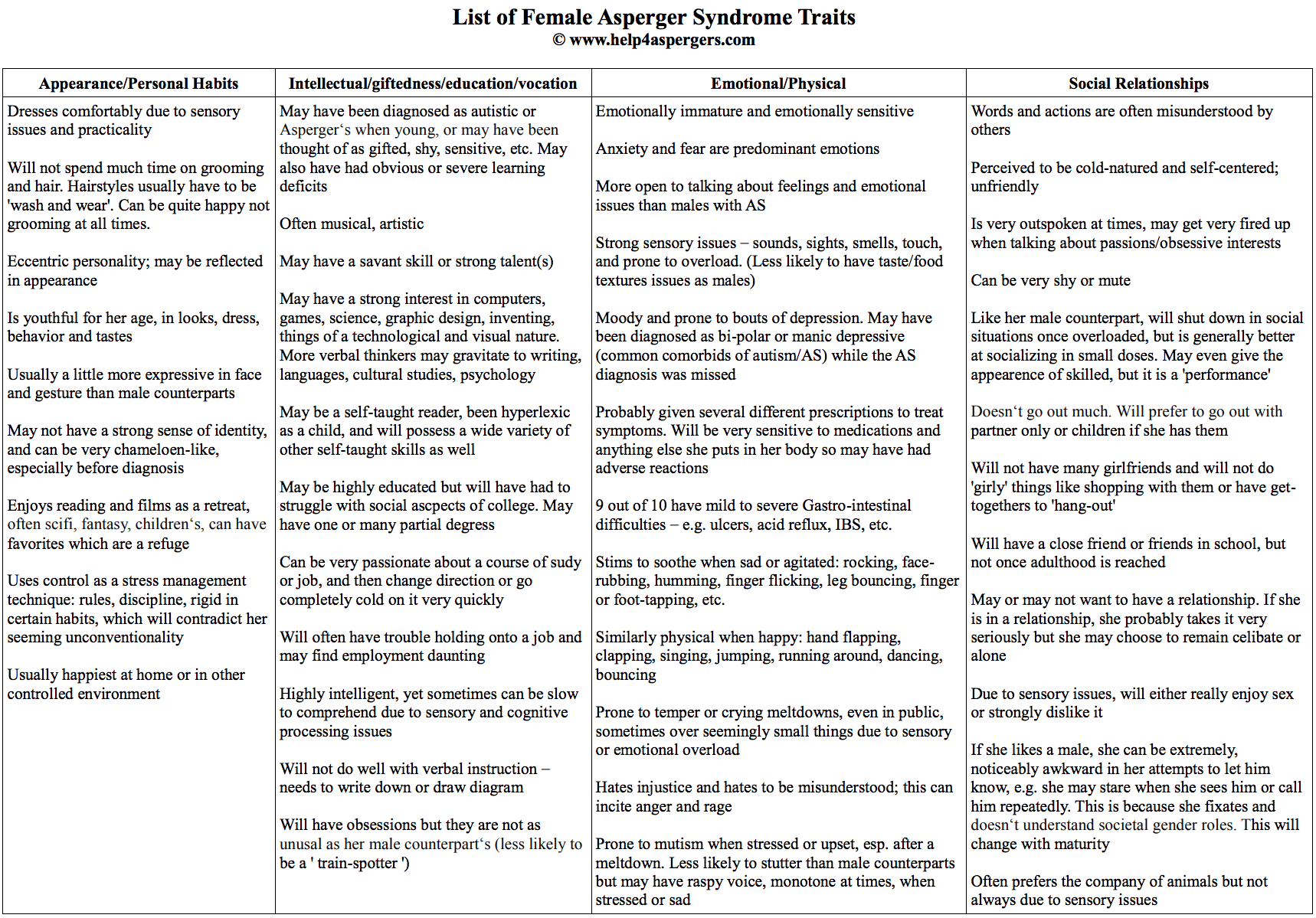
My own diagnosis has been so beneficial, transformative, and life-changing for me. For me, the Ah HAH! moment was when I stumbled across Rudy Simone’s book Aspergirls: Empowering Females with Asperger Syndrome.
Below are the charts from Simone’s book that changed my life and started me on my search:
Simone says of her charts:
“These lists are based on my research. While others may be coming to their own similar conclusions, I based these observations of Female AS on interviews with dozens of diagnosed women of all ages and educational backgrounds, from all over the world. These traits were threads that ran throughout their information and stories, tying us all together. As usual, I do not mean to say that all women with AS will possess all of these traits and I do not like putting us in boxes, but there was a need for an easy-to-read reference.”
While I identify as non-binary, anytime I would wonder if I could possibly be Autistic, I would pull up lists of traits and immediately shake my head, seeing the stereotypical and often male-oriented traits listed. It delayed my diagnosis by literal decades.
This chart was the first step toward self-discovery for me. From there, I found Amythest Schaber‘s Youtube channel, started jotting down realizations in a notebook…then one day, started a blog.
More and more, girls, women, non-binary people are coming forward on Youtube, in blogs and articles, and in person to talk about their experiences as Autistic individuals.
If you want to hear firsthand from other Autistics, check out the podcast Autism Stories, hosted by my friend Doug at Autism Personal Coach. Here are two episodes I appeared in, but there are so many more:
On late diagnosis (Under Seeking Sara, before Autistically Alex launched):
This is a really cool video where she sits down with her Autistic daughter and son, discusses some of the ways that girls and boys Autistic traits tend to vary, and asks them about their experiences.
Amythest is an incredible self-advocate whom I admire a lot. They are educated, sincere, and overall just a wonderful person. Their videos were some of the first things I saw about Autism.
“Who are autistic adults? Like you, we are each unique and you can find us in all parts of your everyday life, not just the stereotypical places you may expect. This April, we are proud to show how diverse autistic people are.” -Mikhaela
My friend and fellow Autistic Mikhaela Ackerman, who runs the blog Edge of Playground, and I have been meaning to collaborate for AGES now, and it finally happened! As April approached, we both found ourselves brainstorming ways to increase positive messages so that Autistics could see some wonderful things against the usual terrible things said about us this month.
Mikhaela had the wonderful idea to do this video, and I jumped at the chance. What a wonderful idea!! Please follow Mikhaela’s blog, Facebook, and Twitter. She is fantastic and very supportive and kind.
A transcript for this video is below.
A huge thank you, too, to the wonderful Autistic people who agreed to do this video!
You can find their information below:
Transcript for “Who Are Autistic Adults?”, a collaboration by Edge of Playground (Mikhaela) and Seeking Sara: An Autistic’s Journey.
(guitar music)
A title screen with “Autistic Adults: Who We Are” written above a rainbow Neurodiversity infinity mark. The screen zooms out slowly to reveal a golden yellow background with many positive words on it including: creative, musicians, caring, proud, mentors, empathetic, thoughtful, spouses, hard workers, poets, interesting, funny, listeners, kind, authors, advocates, etc.
(soft drumming joins the guitar)
A black screen appears, then “A collaborative video organized by:” appears on the screen then fades.
A split screen with both creators’ information appears. On the left: A black background with “Edge of Playground, Tying your shoes is overrated” written and a picture of Mikhaela (a young, white woman) on a swing. A golden infinity mark is at the bottom of her side. On the right: A lilac purple background with the text “Seeking Sara: An Autistic’s Journey” at the bottom. A pink flower is next to a picture of Sara (a young white woman with blue hair), standing in front of Niagara Falls.
The text “Who are Autistic adults” appears on a black screen. (The guitar and drum music fade to the background and disappear.)
(Cheerful and gentle music begins)
Mikhaela (Edge of Playground) appears on screen wearing a floral top. “Autistic adults are everywhere. We are in all parts of your everyday life, even in places you might least expect. We are compassionate friends, artists, teachers, family members, professionals, and so much more.”
Sara (Seeking Sara) appears in front of a multi-colored Tie-dye backdrop. “Like you, we have different strengths and weaknesses. Our strengths are varied, and no two are the same. Success looks different for each person. And one is not better than the other.”
The screen cuts back to Mikhaela who says “We are Autistic people…”
Screen cuts back to Sara who says, “and we’re valuable.”
The screen cuts to black and the words, “Autistic people are just as varied as non-Autistics.”
Arianne, a young Latinx person with long hair appears “My name is Arianne, and I’m an Autistic adult. I’m an editorial board member for Stairway to STEM and a writer.”
The screen switches to Yenn, a white person who is wearing a bright blue top. “My name’s Yenn, and I’m an Autistic writer and advocate.”
Kylie, a young white woman, appears on screen sitting in an armchair. “My name is Kylie and I’m an Autistic advocate, aspiring public speaker, and blogger.”
Shadia, a young white woman with short curly red hair appears on screen wearing headphones. “My name is Shadia. I’m a proud Autistic advocate and I run my own consultancy and mentoring business, Autism Actually.”
Kayla, a young black woman with medium length hair appears on screen. “My name is Kayla Smith. And I am an Autistic adult. I am passionate about disability advocacy and fighting for Autistic rights.”
Adam, a white man with a mustache and beard, appears. “My name is Adam. I’m an Autistic writer, teacher, advocate, and supporter.”
The screen cuts back to Sara who says, “My name is Sara. And I’m an Autistic blogger. I like photography, books, and music. I loved in Japan for several years, and Japanese language is one of my passions.”
Peri, a white woman with dark hair appears. “Hi, my name is Peri. And I am a Autistic blogger. I am very passionate about writing and I feel like my Autism helps me express my feelings in writing like nobody else.”
Mikhaela reappears on screen. “My name’s Mikhaela. And I am an Autistic Corporate Compliance Officer. I am an Autistic advocate and also hold a Juris Doctorate in Law.”
Cynthia, a white woman with glasses and a winter hat and jacket appears. She is standing outside. “My name is Cynthia. I’m a blogger, writer, and advocate at The Neurodiverse Woman. I love to write. I love to cook. I love to be active and go on walks.”
Olivia, a black woman with buns in her hair, appears. “My name is Olivia. I love anime. I like studying Japanese. And I love animals! So yeah!”
Adam reappears and says, “I work for the government at the moment. And I used to work as an English teacher.”
Kylie reappears and says, “I’m creative, compassionate, hardworking, and an insightful individual.”
Shadia appears on screen and says, “I love animals, art, music, and writing. And my dream is to run my own rescue and rehabilitation sanctuary and provide animal-assisted therapy for Neurodivergent individuals.”
Cynthia says, “I love to play tennis, go to hear live music, and hang out with my pets.”
Mikhaela says, “My passions are traveling, reading, writing, and yoga. I’m also a certified yoga teacher.”
Sara appears and says, “I’m a very empathetic and compassionate individual who looks out for my friends.”
Arianne reappears and says, “I’m also an artist and musician. I’ve been singing since before I could talk and I’ve been playing clarinet for 17 years.” Arianne smiles widely at the camera.
The screen cuts to a black background with the words, “You are valued.” In big letters.
Credits begin to roll.
(guitar and drum music from the intro replays)
“Thanks for watching!! Organized by: Concept and Script’ Mikhaela Ackerman. Production and Editing: Sara Earhart. In order of appearance: Mikhaela, Edge of Playground. Sara, Seeking Sara. Arianne, Stairway to STEM. Yenn, Yenn Purkis’ Books. Kylie, Life on the Spectrum. Shadia, Autism Actually. Kayla, @BeingKaylaSmith. Adam, The Proud Aspergian. Peri-Ann, Not Raingirl. Cynthia, Neurodiverse Woman. Olivia, Olive the Lupus Patient. Music credits: “Beyond the Line” by Benjamin Tissot, bensound.com. “Beautiful Morning” by Mixaund, mixaund.bandcamp.com”
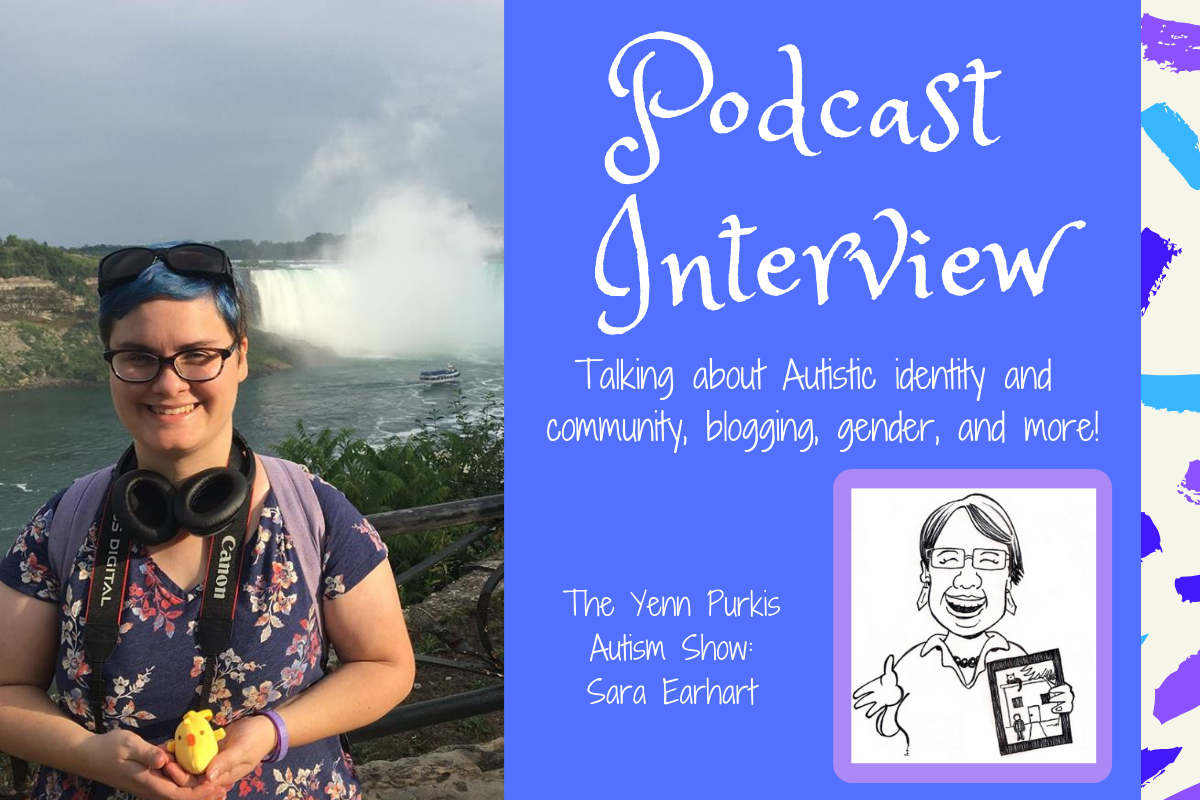
I recently had the awesome opportunity to be interviewed by Yenn Purkis–Autistic author, blogger, presenter, and advocate. Their podcast is called The Yenn Purkis Autism Show (Formerly known as Jeanette’s Autism Show at the time of recording.)
In this episode, we chatted about blogging, the Autistic community, identity, and more!
Click the link or picture below to be redirected to the podcast! Both open in a new tab. (WordPress isn’t allowing me to embed the podcast here for whatever reason.)
[Featured image description: On the lefthand side is a picture of Sara in front of Niagara Falls. Sara has sunglasses on top of her blue hair, noise-cancelling headphones around her neck, and a plushie duck in her hands. On the right is a blue box with the words “Podcast Interview. Talking about Autistic identity and community, blogging, gender, and more! The Yenn Purkis Autism Show: Sara Earhart” A small drawing of Yenn is pictured in black and white. They have their eyes closed and are smiling widely while holding a framed picture of their apartment.]
Today is the day that I share my news with friends and family via Facebook. I was originally going to share my blog with everyone on Friday, but I’m too anxious to wait another day. *paces nervously*
One major reason I started this blog was to have a vehicle to come out to people about being diagnosed as Autistic. Masking my Autism has become so incredibly tiring and I’m really burnt out. I also feel like I’m hiding such a huge part of myself from the people I care about! (See: 6: Why I’m Writing This Blog for more on that.) I’ve been feeling pretty lonely and isolated lately and I want that to end.
So here we are. The story of how I got diagnosed.
Evaluation in Japan
I started my journey by accident in 2015.
I was working in Japan and seeing a Japanese psychologist (who’s fluent in English) for help with the grieving process after losing several people close to me. I’ll call my therapist “S” here for the sake of privacy.
Throughout the years I had sometimes wondered if I might be Autistic, but would pretty quickly decide that it must be impossible–I didn’t fulfill this criteria or exhibit that trait, etc. But I eventually stumbled upon some resources about how women and non-binary on the Spectrum often present very differently than men. (See 13: The Autistics Left Behind for more info on that.)
After delving into research about Autistic women, I tentatively started to let myself consider that I might really be on the Spectrum. I began to take some notes about my life and the way I experience the world as I continued to research about Autistic women. (The baby drafts of this blog!!)
I figured that someday–if I decided to be formally assessed back in the US–I would have all that stuff written down already.
But I didn’t bring it up to my therapist. I was too afraid that she wouldn’t know about women presenting differently and about masking. I was terrified she would immediately shoot me down without assessing me. (It’s not that I was set on being diagnosed as Autistic. I was set on being assessed accurately and thoroughly–whatever the result.)
So I continued to quietly gather information and write down my self-reflections without telling anyone. It was an isolating, but adrenaline-filled time.
It wasn’t until 2016 when I had been seeing S for a full year that things changed. My family had come to visit me in Japan and I showed them around several cities throughout the country, acting as both guide and interpreter. When we were in Tokyo, I experienced an intense bout of sensory overload that led to a subsequent meltdown. (You can read about it in 5: Sensory Overload & Control.)
When I returned from the trip and S asked how it had been, I finally told her. I told her about the sensory issues I’d been having more and more difficulty with, the meltdown in Tokyo, the social fatigue, the wondering, the doubting, the researching–everything. Our session ran over time as she patiently listened to everything spill out. Then I waited as she thought and chose her words carefully.
To my surprise, S had been wondering if I was on the Spectrum as well.
I was really taken aback. I sort of sat there in shock for a moment before a huge smile crept over my face. “Really??” I exclaimed, euphoria rushing over me. Iwas just so relieved that she was taking me seriously.
I printed out the notes I had been writing on my life and handed them over to her during our next session with an anxious excitement. When she returned the pages the following meeting, we talked them over in more detail and she agreed again that she suspected I was on the Spectrum. She asked me to continue writing and agreed that it would be useful if I chose to seek formal diagnosis someday back in the US.
Over the course of the next year, I wrote feverishly. I couldn’t stop. I literally couldn’t stop scribbling insights and realizations onto whatever surface was available. So many things started to make sense about my life and I felt such a sense of relief come over me.
But I still wondered. I went back and forth between good days when I felt more “normal” and questioned myself, and bad days when the truth was presented and reaffirmed right before my eyes through a meltdown or extreme social misstep. I bounced back and forth between denial and acceptance.
Finally, as my time in Japan came to an end, S presented me with a referral letter. At this point, she had seen me in regular sessions for two years, read up on recent research about Autistic women published in psychology journals, and read all of my writing.
On July 10, 2017, she handed me a letter which contained the lines:
“While I have seen Alex, [they have] shown similar characteristics to Asperger Syndrome and Autism, such as sensitivities to various stimuli, panic attack due to sensory overload, fatigue after social interaction, and need to follow schedule rigidly.”
She went on to write that she believed me to be on the Spectrum and was referring me for formal assessment and diagnosis.
That letter was such a gift. I knew that with it, I wouldn’t have to start over completely when seeking diagnosis. I knew I’d have someone in my court (so to speak) and wouldn’t feel like I was going into an assessment completely un-supported.
Assessment and Diagnosis in the US
I began seeing my psychotherapist, M, soon after I returned to the US to get some help adjusting to life back in the US and to address a possible eating disorder. (I will address my eating disorder in a future post.)
After a few sessions, I felt comfortable enough with M to bring up Autism and I gave her the letter from S. She said that she would evaluate me over time as she got to know me, so we continued our sessions and left Autism on the back burner.
By late November of 2017, I wasn’t writing my book anymore. Not for months. I felt like I had stagnated in my self-exploration and realization. After digging deeper, I realized that I was once again doubting if I was actually on the Spectrum.
I brought it up to M and we explored why I was feeling this way. During that session, we realized that–after the initial deluge of self-realization and discovery–I had adapted and started doing things in ways that minimized meltdowns and sensory overload. I wasn’t “less Autistic,” just coping with things better and going through a time when my traits weren’t as noticeable–even to myself.
Next session, she brought in the DM-5 (The Diagnostic and Statistical Manual of Mental Disorders, Fifth Edition) and we sat down and went over the diagnosis criteria.
By the end of the session, I had my final, irrefutable proof. I am Autistic.
I was expecting my road to diagnosis to be an excessively difficult, expensive, humiliating, and stressful process. I know that for many woman, it can be.
I’ve been very lucky. This has instead been a journey of good luck, strange happenstance, and unexpectedly compassionate therapists.
After diagnosis, I’ve been hit with so many unexpected emotions: fear, sadness, excitement, regret, doubt, rage, determination, grief, elation… It’s been an ongoing, never-ending process as I come to terms with who I am.
I feel a sense of grief and loss that I wasn’t diagnosed sooner, but also an odd and bizarre relief that I wasn’t. I feel excited that I finally understand myself. I feel fear for the future and uncertainty as I wonder what the future holds. I feel an internal struggle as I decide what my new boundaries and limits are, and how many of those are worth pushing and how often.
Recently, my overwhelming feelings are isolation and insincerity. More than any of the other emotions, these are ones I can’t bear anymore.
As I share this blog, I feel utterly vulnerable and more than a little terrified. But I also feel excited. I feel free. There’s a freedom that comes with realizing that I can’t control how people react to my coming out. I can’t control it, so why worry about it?
No matter the reactions of those I care about, this is a truth that needs to be shared. It’s time for me to come forward and say, “I am Alex. I am Autistic. I am me.”
Fibromyalgia and the associated chronic fatigue are also things I am passionate about talking and writing about more publicly. They are invisible disabilities that I deal with every day. Fibromyalgia puts significant strain on my pillars and I have to be very careful to take care of myself and manage my pain so that I can function.
Last year I participated in an event called “Keep Talking: a Storytelling Event” where I shared the story of my diagnosis. It was a really nerve-wracking experience to get up on stage in front of a crowd and be so vulnerable. But it was so rewarding and cathartic too!
In future, I’d love to talk about my Autistic journey on stage!
Below is the YouTube video (audio only) of my performance.
Note: I typed out closed captions to make the video more accessible. Please click on the CC button to turn them on. I’m also including the written transcript below for those who prefer reading it or use text-to-speech programs.
I am in pain. Every second of every day. I am in pain. Sometimes it’s a dull ache at the back of my mind. Other times it’s a throbbing, stabbing agony that keeps me bedridden. And I’m always exhausted. Next year will be the 10th anniversary of my official diagnosis, and I have literally forgotten what being energetic feels like.
It started in seventh grade. Sometimes I’d experience a random shooting pain in my leg. Had I somehow twisted an ankle during recess? But the pain would come and go, so I ignored it. Just growing pains. Nothing to see here. Nothing to worry about….
Going into the 8th grade, I started feeling generally unwell. I’d have an intense stomachache, a pain here or there, a crippling headache.… I started going to the school nurse more often than she deemed “normal.” I’ll never forget when she finally turned to me, sighed in frustration, and asked, “Have you been diagnosed with anything mentallywrong with you?” I’ll never forget, because that’s when I started to wonder myself. “I must be a hypochondriac. I’m just looking for attention. I’m just making it up. It’s in my head.” I started to ignore it. To stop mentioning it. To pretend it just wasn’t there.
I joined color guard in high school and I absolutely loved it! But toward the end of my second season I was having wrist and shoulder pain too severe to continue. I joined the choir, but struggled to stand through performances. I began to feel exhausted. I went to the choir director’s office to rest during free periods. Pretty soon I started seeing a chiropractor for back pain. It felt like I was hanging on by a thread. But I got through it and I graduated!
The first semester of college, I got the flu. A bad flu—one that sent me to the ER. And I just never really got better. Imagine your worst flu. Now imagine it doesn’t end. It doesn’t go away. No Tamiflu. No bouncing back. My body ached. Those pains I’d been feeling for years intensified. They’d now shoot up and down my body like fire and lightning mixed into pure hell. I felt nauseous all the time. I was beyond exhausted. This was a new realm of agony.
I began missing classes when the pain in my legs and back was so bad I was unable to stand. I started getting “medical escort” rides to class from campus security. I’d sit in the back of their patrol cars, literally locked in—with a metal grate between me and the driver—and they would drive me to my classes, glancing at me in the rearview mirror. I’d feel embarrassed because I was this outwardly healthy-looking college brat they were ferrying to class. I’d hobble into the building where I’d often be late to class because the football team would inevitably be using the elevators… In class, I’d sometimes have to lie on the floor to take notes because my back was spasming so hard.
During school breaks, I’d see doctors. My college spring break experience? Doctor visits. Over the years, I’ve had dozens of blood tests, biopsies, MRIs, cat-scans, EKGs, EEGs, spinal taps…. I saw an endocrinologist, neurologist, psychologist, gastroenterologist, then finally:a rheumatologist.
I was 18, still a freshman in college, when I got an answer. The test was almost infuriatingly simple. A few touches here and there. Testing tender, inflamed points throughout my body…. Fibromyalgia.
I was so happy. I remember chattering to my father all the way home about how happy I was. If you haven’t waited years for a diagnosis, haven’t wondered if you’re crazy or weak or just “sensitive,” maybe you won’t understand. But I was just so relieved. Those of you doing the math will know:I waited 6 years for that moment. And half of the time, I wondered if it really was all in my head.
But that relief soon became a devastating grief. A quick online search showed me- it’s not so simple as just getting a diagnosis. “Incurable. Treatment can help, but this condition can’t be cured.” So…no magic wand. No fixing me.
And this is the reality for an estimated 10 million Americans with Fibromyalgia. Unfortunately, my story is not uncommon. Those with invisible disabilities often go through years of misdiagnosis or being written off. Many are told “It’s all in your head”—often by medical professionals. I stand here, on this stage, in front of you all. And I look healthy. I look fine. But I’m not. And I probably never will be.
But… I haven’t stopped trying. I can’t. I refuse to stop living my life, even if it’s sometimes very, very hard to continue. In my junior year of college, I reached my lifelong goal of studying abroad. Twice. I graduated with honors with a self-designed major. Learned Japanese. Worked at the Smithsonian Museum. Lived and worked in Japan for three years. Joined a Japanese choir and competed in a national competition. Got married to my best friend.
Fibromyalgia is not fun to live with. But it has taught me some things. I learned who my real friends are—the ones who will stick by me even when I cancel plans for the 3rd and 4th time. I learned to trust myself and my instincts, to be my own advocate. I learned that I will push a broken body to its limits rather than give up. I learned that I can get through what feel like insurmountable challenges. And I learned to never, ever assume that someone who looks “fine” isn’t dealing with something enormous.
I will never say that I’m grateful for fibromyalgia. But I am grateful for what I’ve learned about myself. I am strong. I am a superhero. And I’m not giving up.
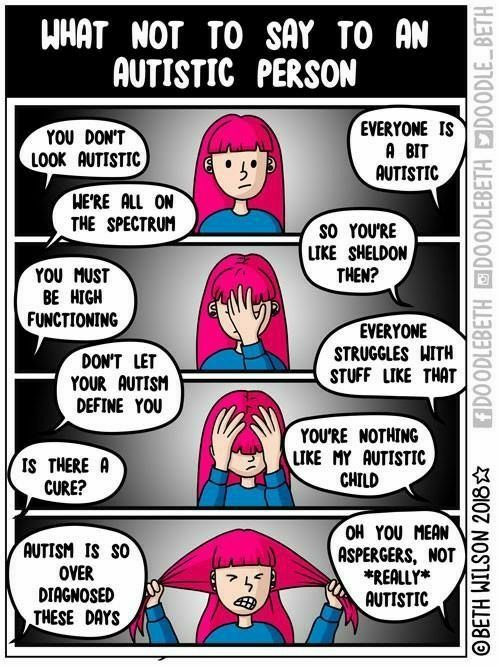
So I’ll admit, I haven’t had a ton of experience in this yet because I haven’t told many people about my diagnosis (and therefore haven’t gotten bad responses!). Never mind. That ship has sailed.
But I know what I fear people will say. I’d love it if everyone could take a quick look at these things and try to avoid them. But I also don’t want people feeling like they can’t talk to me and if they make a mistake, it’s game over! I understand that you might feel put on the spot. I understand that you might mean well with a comment. It’s ok to make a mistake and say something wrong as long as you’re open to learning why it’s hurtful and changing what you say.
I’m not going to go into much about why I don’t want people saying these things to me (or any other Autistic person) because it’s already been done before!! These blogs, articles, and videos are done by Autistic people who have gone through this, so I want to feature their experiences and advice.
Here’s some other Autistic peoples’ lists and explanations:
Amythest Schaber- Ask an Autistic #12: What Shouldn’t I Say to Autistic People? video
No need to read and watch all of these links above (unless you want to, in which case ALL THE BROWNIE POINTS!), but at least checking out some of these resources would mean a lot to any Autistic person you interact with.
If you’ve read the post on my homepage, you’ll have a pretty good idea of why I started this blog.
I have three main goals:
To look back at my childhood and the years before diagnosis, see where I started to mask my Autistic traits and to mimic “normal” behavior, and find who I am authentically.
To give people on the outside a look into an Autistic brain and life.
To reach out to others like me who have gone (or still are) undiagnosed or misdiagnosed.
There’s another goal though. I’ve grown so much since I started to realize I might be on the Spectrum, and even more so since my official diagnosis. But it’s been pretty lonely. I’d love to connect with some fellow Autistics.
But I’d also like to more fully connect with my friends and family. Carrying around this secret has been really exhausting and isolating. I don’t feel like I have very many people that I can talk to about it all and that’s been frustrating and scary. I don’t feel ashamed or embarrassed about being Autistic and I don’t like feeling like I’m lying.
I also hope that sharing this blog with friends will help them understand my behaviors more. They’ll know why I sometimes wear ear plugs or make multiple trips to the bathroom at a restaurant (See: sensory overload). They’ll see how much energy goes into everything that I do. They’ll understand why I have to cancel plans sometimes even when I really, really want to see them.
I would love to talk about Autism openly!
If you are a family member, friend, or acquaintance, know that I don’t want you to tiptoe around me or my Autism. I don’t want you to feel uncomfortable or to treat me like I’m fragile. And I don’t want pity. I love to talk about Autism and being Autistic (it’s who I am and I love me!) and welcome dialogue when I have the energy. I only ask that you see my post on “What Not to Say” to an Autistic. It’s ok if you make mistakes (if you’re willing to learn), so don’t stress too much. Don’t feel like you need to walk on eggshells!
I won’t lie. I keep going back and forth about whether or not I should share this blog with anyone. It terrifies me sometimes. But it also excites me! And the thought of continuing to live with this secret and my masks is much more horrifying to me than being open and honest about who I am.








 Autistically Alex